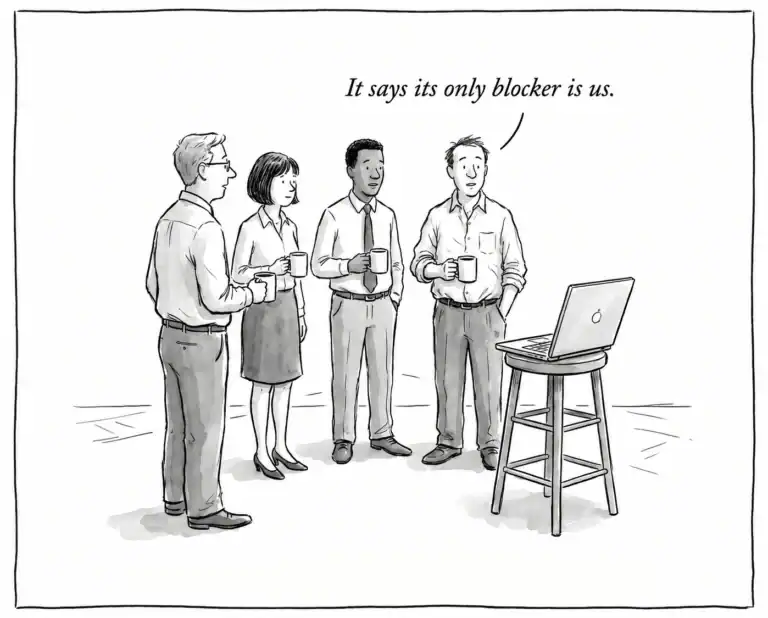
A vibe coding cleanup specialist is the person you call when your business starts depending on an AI-built app. Nobody is sure it is safe, and the person who built it may already have left. The job title started as a LinkedIn joke in 2025. It has since turned into a line of business, because the apps are real. McKinsey’s 2026 State of AI survey found that 32% of organizations had dropped at least one software purchase. They decided an agentic coding tool could build the product or feature in house. On October 28, GitHub told Enterprise customers they can now pay for Copilot by the AI credit alone. Pricing like that puts an app-building agent within reach of any department with a budget line.
Is vibe coding bad?
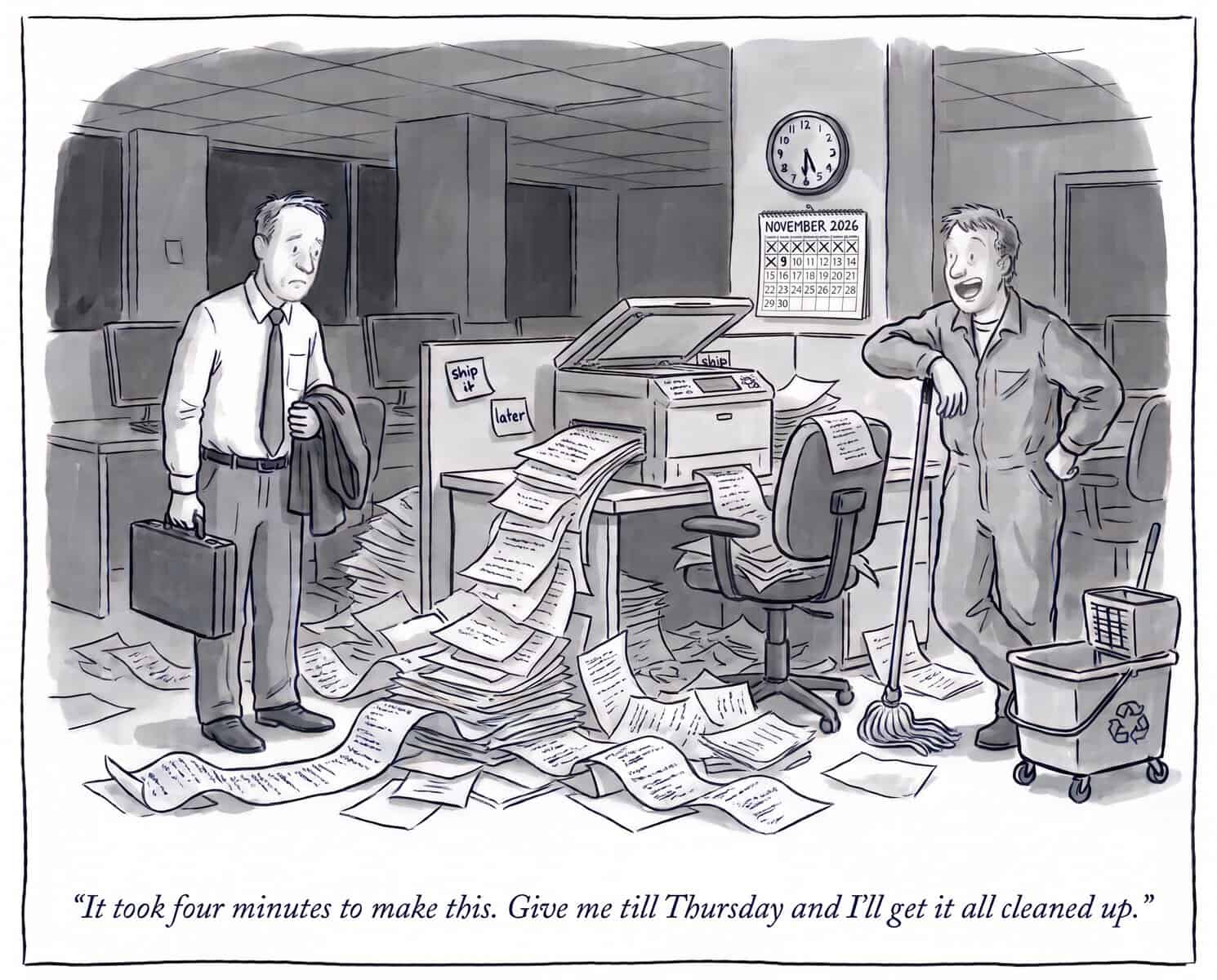
The question “is vibe coding bad” tends to come from owners who already have one of these apps running. The answer depends on who maintains the result. A prototype a manager builds in a week is fine as a prototype. The trouble starts when the company keeps using it and connects it to customer data or the accounting system. Nobody has the job of patching it, reviewing it, or fixing it when a connected service changes. Most of the cost of an internal tool arrives after the build. A vibe coding cleanup specialist prices that cost, reduces it, and takes it over.
One of our clients is weighing a move off WordPress to a vibe-coded site. They believe it will cost less and need less upkeep. The part of that calculation still missing is what they would give up. WordPress brings two decades of patching, a core security team, and a community that has seen every breach pattern. A vibe-coded site has its own security and performance problems. When one surfaces, the only person who knows the code is whoever built it.
Another vibe-coded site I tried to use recently was for signing up to join a webinar. Except I had to have a login to get the webinar link. I knew I had once created an account with this site, but when I tried to log in, it didn’t recognize my password. Crucially, it also didn’t give me a “forgot password” feature. Somewhere in the process of building the site, the AI left out this simple but essential piece of functionality. These are the kinds of sites that need rescue rebuilds.
What a vibe coding cleanup specialist prices first
A vibe coding cleanup specialist starts by pricing the app the way you would price a delivery van. The purchase is one line among several. For most internal tools the build is the cheapest line on the list. The lines below it are the ones nobody budgeted when they approved the prototype.
| Cost line | When it shows up | Who usually ends up paying |
|---|---|---|
| Hosting, accounts and credentials | Month one | IT, once someone tells them the app exists |
| Platform and dependency upgrades | Every few months | Whoever notices the app stopped working |
| Security review of the code and its data access | Before launch in theory, after an incident in practice | Nobody, until an auditor or an attacker asks |
| Fixes when a connected system changes its interface | Without warning | The builder, if still employed |
| Knowledge transfer when the builder leaves | At the exit interview, if at all | The next person, starting from zero |
CIO’s reporting this spring quoted Eno Reyes, CTO of the coding-agent vendor Factory. He said a full SaaS product usually exists because a large team has spent years maintaining it. Those years of maintenance are what a subscription price buys. They are also what an internal build has to replace with its own people and its own calendar.
Why the cleanup starts with a security review
Veracode tested 18 AI models in its fall 2026 round, across Python, C#, JavaScript and Java. The average security pass rate was 62%, up from 56% in July. Java sat at 31%, and the best models in the test reached 73%. In plain terms, AI-generated code passes a basic security check somewhere between one third and three quarters of the time. It depends on the language and the model. The person generating the code usually cannot tell which cases failed.
Veracode’s own conclusion is to pair generation with continuous, independent verification. It notes that a mid-tier model plus scanning can beat a frontier model with no verification at all. For a company with no security engineer, that means paying for a review by someone outside the build. The review has to happen before the app touches customer data or the accounting system. It belongs on the cost table above as a recurring line, since every upgrade to the app reopens the question.
The review matters even when the stack is sound. Another of our clients left WordPress this year for a rebuild they first planned to do on Lovable or Manus. In April, China’s planning agency blocked Meta’s acquisition of Manus. We proposed a different route: a site built with Claude, versioned in GitHub and hosted on Cloudflare Workers & Pages. Claude Code prompts let their own team add page sections and whole new pages. We control design drift with Claude orchestrating foundation changes vs. simple content changes. Foundation changes go through team gatekeepers. The move removed the usual WordPress attack surface, since the site has no PHP runtime or plugin directory to probe. It also rests on Astro and Node.js, so the npm supply chain is now the risk to watch. That goes on the review calendar like any other line in the table.
Keep it, rebuild it, or replace it with a product
Answer these for the specific app, in writing, before anyone opens a coding tool or signs a contract. Each answer leans one way, and a vibe coding cleanup specialist will ask all five on the first call.
| Question | Answer that favors replacing it with a product | Answer that favors keeping or rebuilding it |
|---|---|---|
| Does this process set you apart from competitors? | No, every company in your field does it about the same way | Yes, and no vendor fits the way you do it |
| How often will the requirements change? | Rarely, and in ways vendors already handle | Every quarter, in ways a vendor will never follow |
| How many people depend on it every day? | Dozens or more, across teams | A handful, in one team |
| What does a day of downtime cost? | Lost revenue or a compliance problem | An inconvenience you can work around |
| Does a vendor already do this well at a price you can accept? | Yes | No, or the price scales badly with headcount |
Count the answers, then read the result against the cost table. An app that leans toward replacement on three of the five questions goes to a vendor product. So does one that leans the other way yet has nobody assigned to maintain it. An app that leans toward keeping on four of five becomes a scoped rebuild. That is doubly true when it holds data you would never let a vendor control or see. The last section covers what that rebuild looks like.
How to avoid needing a vibe coding cleanup specialist next time
Employees will build things whether or not the company has decided to. In CIO’s March reporting, Blake Crawford of Fusion Collective described an accounts payable clerk building add-ons for his SAP workflow. Geoff Burke of Object First warned that giving the tools too much autonomy produces inaccuracies and bypasses security norms. The cleanup then takes twice as long as the build. Adam Arellano of Harness added that these tools produce software faster than a company can absorb it. A few rules contain that problem.
- Keep a register of every internal tool, with a named owner and a list of the data it touches. (We help our Astro/Node.js/GitHub/Cloudflare client maintain this list.)
- Run build tools on accounts with the same access limits the builder already has, and nothing more.
- Have a second person review the code before it reaches production data.
- Keep new tools away from production systems until that review finishes.
- Put a review date six months out on every tool. On that date, keep it, replace it, or retire it.
Under these rules the prototype still takes a week. What changes is the Monday after it works. That is the point where most of the cost in the table above starts to accrue.
When to hire a vibe coding cleanup specialist
Hire a vibe coding cleanup specialist when an app has passed from prototype to dependency. A sure sign is that the person who built it is the only one who can explain it. A good engagement takes the five questions above and writes the specification the original build never had. It puts the code through an independent security review. It fixes or rebuilds what the review finds, using the same AI tools your staff used. Then it sends the app back with documentation and a retainer for the upkeep. The company keeps the fit of an internal build. It also gains a named party on the hook for every line in the cost table.
Sometimes the work ends with a recommendation to replace the app with a product. That is a cheap answer to get before a team commits months to the alternative. Webidextrous does this work for companies that want that answer first.
If your company already has an app someone built on their own this year, start with the register. Then run the five questions on it, and price its maintenance before you price the next build. A vibe coding cleanup specialist costs less to call before the build than after it. We can help you get the project going.
Sources
- McKinsey, The state of AI in 2026, August 25, 2026: 32% of organizations decided against buying software they could build with agentic coding tools.
- GitHub Blog, GitHub Universe 2026, October 28, 2026: Enterprise customers get all Copilot features without a separate subscription and pay for the AI credits they use.
- Veracode, GenAI Code Security Fall 2026, October 29, 2026: 18 models tested, average security pass rate 62%, Java 31%.
- CIO, Vibe coding your own enterprise apps is edgy business, March 26, 2026: practitioner interviews on maintenance, technical debt and governance of employee-built apps.
- AP via WGCU, China blocks Meta from acquiring AI startup Manus, April 27, 2026: China’s National Development and Reform Commission prohibited the foreign acquisition of Manus and required the parties to withdraw.