I was at the Pantheon.io GoLive conference in Miami last week, where almost every session included a discussion of how AI is changing everything. I got to thinking about how much it has changed how our agency does Agile development. When was the last time we actually followed the methodology as closely as we used to before AI? I couldn’t remember.
Is Agile dead?
The death of Agile looks plausible once you watch an AI coding agent work. Sprint planning asks how much code a team can write in the next two weeks. Story points, velocity charts, backlog grooming, and the daily standup all grew up around that question, because developer hours were a scarce resource.
An AI coding agent can now draft a feature while the meeting about it is still running. That changes what a sprint is for. It also raises the value of the experienced people on your team, and the research from the last two years shows why.
Agile was built to ration human coding hours
Predictions about the death of Agile describe Scrum’s estimation rituals. Seventeen people met at the Snowbird ski resort in Utah in February 2001 and wrote the Agile Manifesto. Its first principle reads: “Our highest priority is to satisfy the customer through early and continuous delivery of valuable software.” Another says, “Working software is the primary measure of progress.”
Scrum turned those principles into a schedule. A team commits to two weeks of work and sizes each task in story points. Velocity, the count of points finished per sprint, tells managers how much to promise next time.
All of that machinery assumes a person will type the code, and the person is expensive. The Bureau of Labor Statistics puts the median software developer wage at $135,980 a year as of May 2025. Teams learned to guard those hours. Requirements got argued over before code was written, because building the wrong thing burned a sprint.
What a line of code costs now
AI now writes most new code at Google, and the price of generating it keeps falling.
| Measure | Figure | Source |
|---|---|---|
| New code at Google that is AI-generated and approved by engineers | 75%, up from 50% the previous fall | Sundar Pichai, April 2026 |
| Technology professionals who use AI at work | 90% | DORA 2025 |
| Price decline for GPT-4-level performance on PhD-level science questions | 40x per year | Epoch AI, March 2025 |
| Claude Sonnet 5.5 output price | $10 per million tokens | Anthropic pricing |
Put the last row next to the wage figure. A developer earning the BLS median makes about $65 an hour across a 2,080-hour work year, so $10 covers about nine minutes of that developer’s time. The same $10 buys a million tokens of generated output. At ten tokens per line, an assumption that shifts with the programming language, a million tokens comes to about 100,000 lines.
Agents spend extra tokens reading files and retrying, so a finished feature costs more than its line count suggests. Generated lines also have to be reviewed and maintained, which is where the cost translates to.
Where the death of Agile is real: story points and velocity
Story points estimate how hard a task is to code. When an agent drafts the task in minutes, the estimate ceases to be meaningful, and velocity goes with it.
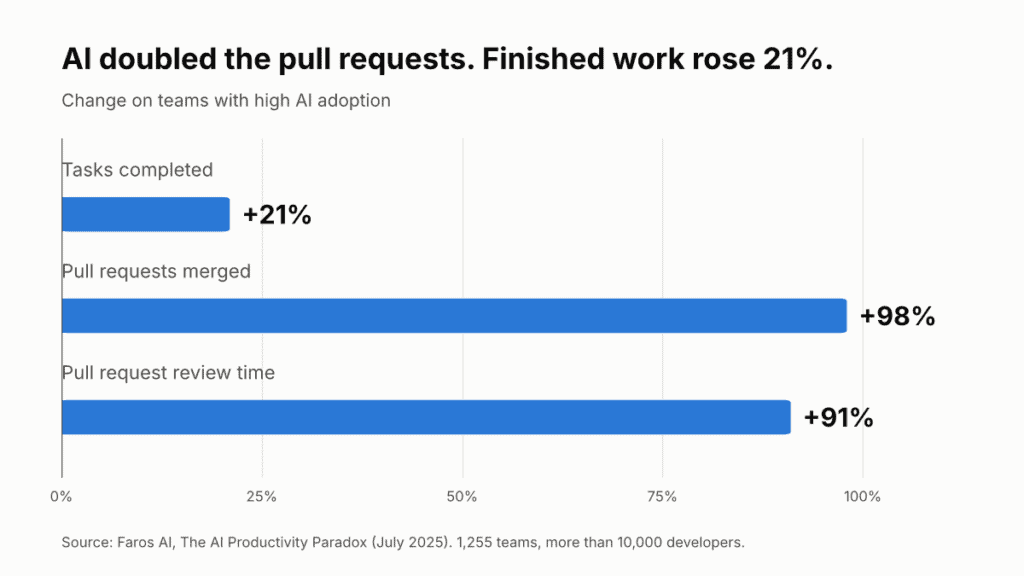
Faros AI measured the effect across 1,255 teams and more than 10,000 developers. Teams with high AI adoption completed 21% more tasks and merged 98% more pull requests. Pull request review time on those teams rose 91%. Twice the pull requests bought only a fifth more finished tasks.
The Faros data points to review as the new constraint. Code now waits in a queue for a qualified person to read it, and that queue sets the pace of delivery. Sprint planning has to start from how many changes the team can read closely and stand behind in two weeks.
The daily standup shifts for the same reason. “What did you code yesterday?” matters less once agents work overnight. Dev leads need to hear which agent output is waiting on a decision.
Why people still have to be in the loop
Anyone betting on the death of Agile should read the quality research first. AI raises output. DORA’s 2025 report found a positive relationship between AI adoption and delivery throughput, and the same report found that stability still suffers. Four other research groups describe what goes wrong.
| Finding | Source |
|---|---|
| AI adoption continues to have a negative relationship with software delivery stability. The 2024 report estimated a 7.2% stability reduction for every 25% increase in AI adoption. | DORA 2025, DORA 2024 |
| AI-generated code passed security tests 56% of the time on average, almost unchanged from a year earlier. | Veracode, July 2026 |
| Across 211 million changed lines from 2020 through 2024, copy-pasted lines rose from 8.3% to 12.3%. Refactored lines fell from 25% in 2021 to under 10% in 2024. | GitClear 2025 |
| 46% of developers distrust the accuracy of AI tools and 33% trust it. The top frustration, at 66%, is “AI solutions that are almost right, but not quite.” | Stack Overflow 2025 |
| Experienced open-source developers took 19% longer with early-2025 AI tools. They believed the tools had made them 20% faster. | METR, July 2025 |
METR reran the study with late-2025 tools and saw signs of a speedup, though it calls the new data very weak evidence. The tools improved. Developers in the first study also misjudged their own speed by a wide margin, so somebody has to measure outcomes.
A model writes code that satisfies the prompt in front of it. Knowing why the billing module was built a certain way, or that a client faces an audit next quarter, takes someone who has lived with the system. That person also answers for the outage.
Google keeps its engineers in the loop too. Pichai described the 75% as code “AI-generated and approved by engineers.”
Why the death of Agile is overstated
Agile is a stronger bet today than it was before AI coding tools, because the practices Google’s DORA research links to successful AI adoption overlap with the ones Agile teaches. Research backs the first three reasons below, and the fourth is our own argument.
- Small batches protect stability. DORA lists working in small batches among seven capabilities that magnify AI’s benefits, as a way to get “shorter lead times and faster feedback loops.” Its 2024 report named small batch sizes and robust testing as the basics teams skip when AI speeds them up.
- User focus aims the speed. DORA’s 2025 announcement calls user-centricity “a prerequisite for AI success.” An agent can build the wrong feature quickly, so frequent contact with users matters more than it did.
- Short increments keep review possible. Review time rose 91% on high-adoption teams in the Faros data. Small changes are the ones a reviewer has time to read with care.
- Iteration got cheaper. Responding to change once meant throwing away weeks of paid work. A team can now build a rough second version and let a customer choose before polishing either one.
DORA’s findings are correlations drawn from a survey of nearly 5,000 professionals, and they cover individual practices such as batch size. The claim holds for Agile’s principles of short loops and working software. Story points and velocity charts get no backing from this research.
Sprint changes that outlast the death of Agile
Sprints still work once they measure review capacity and working software, which is why the death of Agile keeps getting postponed.
- Plan each sprint around review capacity, counting the hours senior people have for reading code.
- Write the acceptance criteria before an agent starts, because the agent fills every gap in the spec with a guess.
- Cap the size of every change so one person can review it in a reasonable time span. About 15 minutes maximum.
- Show working software to a user every sprint, and treat that feedback as the measure of progress.
Job descriptions shift too. Developers spend more of the day directing agents and checking results. Leads own the decisions an agent cannot make, such as which trade-off the business can live with.
Webidextrous helps companies build this review loop around AI-assisted development. Tell us where your delivery slowed down at webidextrous.com.
Sources
- Agile Manifesto: history and principles
- Bureau of Labor Statistics, Occupational Outlook Handbook: Software Developers
- Sundar Pichai, Cloud Next 2026 remarks, April 22, 2026
- Google Cloud: Announcing the 2025 DORA Report
- DORA capabilities catalog
- Google Cloud: Announcing the 2024 DORA Report and the full 2024 report
- Epoch AI: LLM inference prices have fallen rapidly but unequally across tasks
- Anthropic pricing
- Faros AI: The AI Productivity Paradox
- Veracode 2026 GenAI Code Security Report announcement
- GitClear: AI Copilot Code Quality, 2025 research
- Stack Overflow 2025 Developer Survey: AI
- METR: early-2025 developer productivity study and February 2026 update